skip to main |
skip to sidebar
When I was growing up Malayalam cinema was something that inspired awe among cineastes from other parts of the country. Not just because we had an Adoor and an Aravindan, but because the standard of popular cinema was abnormally high and the Malayalam audience were quite discerning. The actors and technicians were slaves to their craft and mindless cinema didn’t quite exist. (There was also another Malayalam cinema that was the toast of teenagers with raging hormones across the country. But this is not about that!)
Then things changed. A breed of lazy, misogynist filmmakers decided that aging actors shouting bombastic one-liners and aping Rajni’s fight sequences was the new mantra to success. It lasted more years than it should have. I moved away almost completely from Malayalam cinema. My rare visits to the home town would always include a visit to DVD shops, but that was to check if any new CDs had come out, of cinema created by MT and Padmarajan.
Recently, however, the youth are striking back. Bless them! There is a tsunami of young fearless filmmakers all out to tell their stories in their own way. They favour a realistic style as opposed to the theatrical. They are eager to try new faces and they want actors and not stars. A decade later people will start talking about this as the Malayalam New Wave. I was aware of this, but too immersed in the Golden Age of Television. My loss, as I am discovering.
With a New Year and a resolution I am quite hell-bent on keeping, I asked a filmmaker friend for a list, got most of them and started watching one a day. Here’s my first set.
Anuragha Karikkin Vellam (Director: Khalid Rahman)
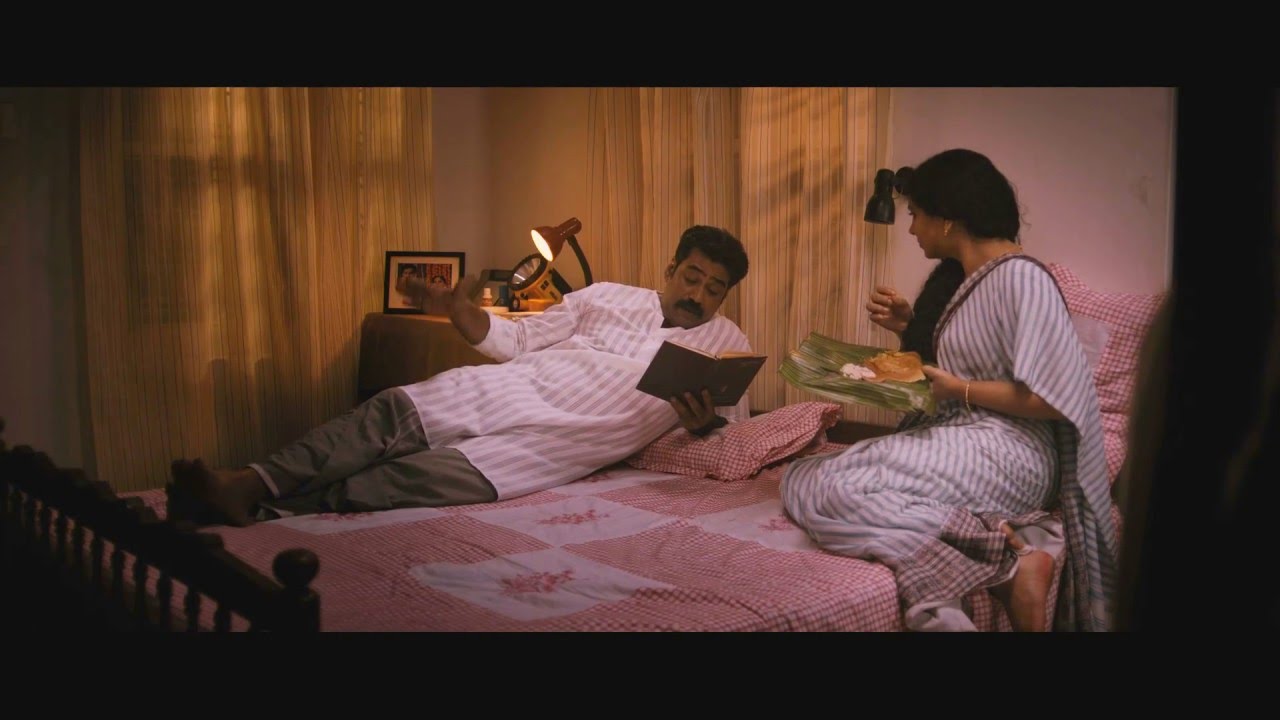
There are two love stories in Vellam. The first is that of Abhi (Asif Ali) and Eli (Rajisha Vijayan). The two are already a couple when the movie starts and gradually you see a falling-out-of-love story. The other is that of Raghu (Biju Menon) and his Suma (Asha Sharath). The two have been married for many years and have a ho hum existence, barely acknowledging each other. And their falling-back-into-love story is one of the most mature portrayals of adult love I have seen in a long time, despite (or, maybe, because of) director Khalid not spending too much screen time on them.
Abhi is a struggling architect who works with a white boss (Tom Alter in a Laurie Baker homage) designing low-cost housing for the poor. He dreams of moving to the big league, but this is life and not movies. He has a long-time girlfriend Eli who he feels is too clingy but he can’t summon the nerve to break up with her. His dad, Raghu, is a grumpy cop who has his heart in the right place.
One day Raghu catches a glimpse of Anuradha (his former flame). He tries to get in touch with her. In the thinnest of cinematic conceits Raghu calls up a phone belonging to Eli and she pretends to be Anuradha. Now the scene is set for a hot extramarital affair. Except that Khalid has no intention of going down that road. Raghu’s telephonic conversations make him alive. Egged on by Nandini aka Eli’s suggestion he shares details of these conversations with his wife and their relationship slowly sparks again. Meanwhile, Abhi and Eli are on their way out.
This might be Biju Menon’s most nuanced performance. Though enacting the role of a hothead, the restraint he shows in the other scenes is remarkable. This might be as good a time as any for name-dropping! During my childhood I have played cricket quite a few times with Biju Menon. We used to make fun of his blink-and-you-miss scenes in TV serials, but now he has become irreplaceable in Malayalam movies.
Asha Sharath has a brief and thankless role, but she executes it perfectly. Asif Ali has a meaty role, but is not able to shake off the feeling that it is just a prop for the Biju Menon show. Debutante Rajisha Vijayan is a real find. It is going to take a series of unfortunate events to prevent her from being much sought-after in the near future.
Writer Naveen Bhaskar and director Khalid intersperse the dramatic elements with dollops of clean comedy. The movie passes by at a fair clip while keeping the viewer really hooked. Without resorting to gimmicks they slowly subvert expectations. So slowly, in fact, that you realize how many unexpected turns the movie took only later. The producer roll-call includes Santhosh Sivan and Prithviraj, showing that despite being a debutante Khalid Rahman was able to impress veterans with his story.
Kismath (Director: Shanavas K Bavutty)
How far will you go for love? What obstacles will you overcome? And at the end do you know what fate has in store for you?
Based on a real story, Kismath follows 23-year-old Irfan (Shine Nigam) and 28-year-old Anitha (Sruthi Menon) as they try to get police protection from their relatives who are, naturally, opposed to their union. Irfan, an Engineering student who spends his time customising superbikes, is from a well-to-do Muslim family, while Anitha is a research scholar who comes from a poor Hindu background.
Most of the action happens over the course of a few hours in the police station in the town of Ponnani. There are a few flashbacks and flash-forwards, but the heart of the movie is in the cop-house. While awaiting their turn to meet the Sub-Inspector (a very solid Vinay Fortt, moving away from being the poor man’s Jayasuriya) the couple see the life happening in a police station, including a motor accident involving an Assamese (Mollywood recognised its minorities much before Hollywood!) a corruption case involving a senior cop and a chair that needed repairing!
Kismath’s USP is its stark realism. While many such movies tend to move towards art-film category, debutant director Bhavakutty ensures this is not the case here by cutting across sequences rapidly. The most intensive action that happens may be two people shouting, but still he is able to keep the movie constantly in motion. The cinematography by Suresh Rajan is a revelation.
The acting is uniformly excellent. Shine Nigam may not have typical leading man’s presence, but he is born to this role. He does not speak much here, but his face takes us through all the emotions a vulnerable young man who finds himself at the crossroads of his life. Sruthi Menon is an able foil. She subtly portrays a woman who is in a relationship with a much younger boy and, at times, need to take the lead. There are very few familiar faces and this brings an intimacy to the film.
The only grouse I have is a sort of post-script after the first end credit appears. It serves no other purpose, other than to, maybe, convince us that this was based on a true story and this is what happened afterwards. It detracts from a very satisfying conclusion and rubs off some of the sheen of an excellent movie.
Ann Mariya Kalippilanu (Director: Midhun Manuel Thomas)
When was the last time you saw a children’s movie that appealed to adult sensibilities? One that left you smiling and not cringing? If you can’t recall, I suggest you go check out Ann Mariya.
Ann Mariya (the extremely expressive Sara Arjun) is the offspring of two doctors Roy (Saiju Kurup) and Treesa (Leona Lishoy). Roy is working with the Red Cross in Syria, while Treesa brings up Ann alone. Ann is a budding athlete who wants to excel in long jump.
One day Ann overhears a conversation between David, the Physical Education teacher, and her English teacher. Though too young to understand all that was said, the spunky girl went and told this to the principal. David found out who was responsible and disqualified Ann in long jump. Hell hath seen no fury like a schoolgirl scorned. And what do you do when you are angry with someone? Hire a goonda to beat them up. Enter lazy no-gooder Poombatta Gireesh (Sunny Wayne) and his sidekick Ambrose (Aju Varghese). They take Ann’s payment – an iPhone 6 – and scram. Little did they know who they were dealing with.
Ann and Gireesh begin an unlikely friendship which leads to him turning over a new leaf and the two of them exacting their revenge on David. All’s well that ends well. There is also a small case of an angel, but I am no spoiler!
Ann Mariya succeeds by making us care for the characters, but doesn’t descend into sentimentality. The humour is fresh and lively and the scenes do blend into the next. Sara Arjun is the heart of the movie and it is extremely hard to believe that she is not the nice Malayali girl that Ann is. She and Sunny make for one of the unlikeliest screen pairs in recent times. John Kaippallil does a PG version of Keerikkadan Jose as David, the bad guy. Some of his scenes with the schoolgirls actually points towards a much darker role than what you expect from a kids’ movie. The scene-stealer is, however, veteran Siddique who is brilliant as Perumkudy Baby, a local businessman who plays a big part in Gireesh’s transformation.
The movie works on the assumption we buy into a mother allowing her young daughter to have a friendship with an adult male just because the maid says that he has become a good guy. But if we can believe kuttichathans exist then this is not an issue at all!
Kammattipaadam (Director: Rajeev Ravi)
Real estate. The one commodity that will grow in value and become rarer as time goes by. In Malayalam, ‘earth ’ and ‘blood’ seem to gel well in sentences. And not without reason. There is usually blood involved in getting earth, and not just the ‘blood and tears’ variety. More ‘blood being spilt’. Kammattipaadam tells a small part of the blood that went into making Kochi the place it is now.
Krishnan’s family moves into Kammattipaadam village in the late 70s. He grows up with his friend Ganga. They both look up to Balan, Ganga’s elder brother, who is a small-time hoodlum. As time passes by, they become entwined in the criminal way of life that is around them. Krishnan is also enamoured with Anitha, Ganga’s cousin. They become enforcers for the real estate mafia.
In the present day, Krishnan (Dulquer Salman), who is working as a security guy in Mumbai, receives a call from Ganga (Vinayakan). A call that convinces him to journey back to Kammattipaadam. Between flashbacks and present day we see the story unfold.
There is a lot of caste politics in the movie, which I leave to the better informed to talk about. I am more concerned about the story, and it is riveting. There are no excuses offered for anyone’s actions and no attempts to whitewash the criminal past or glorify it. We are all slaves to our environment and that is what will define us.
Vinayakan has been around for many years in bit roles. But, as Ganga, he goes all for broke. It will be the role he will be remembered for and one he is unlikely to get a chance to repeat. As the unread, uncouth, unthinking Ganga he makes us care for someone who does not deserve it. Manikandan shines as Balanchettan, whose actions and choices are what drive the story forward.
There are excellent supporting performances from Alencier Ley Lopez and Suraj Venjarammoodu, including a rare serious cameo by the omnipresent Soubin Shahir, which initially seems unnecessary, but actually plays a big part in establishing the myth of Balanchettan.
Dulquer is fine. He happily plays foil to the more showy performances and actually convinces us in his 40-year-old avatar. But whatever he does, his looks prove his undoing. We cannot shake the feeling that he is a movie star. One who cannot be part of that milieu. When everyone looks the part, he alone strikes a false note.
We know with whom Rajeev Ravi’s heart lies, but he makes it a point not to add rose petals when the thorns need to stay out. By using flashback and treating the story primarily as a whodunit, he immerses us into unfamiliar surroundings. Kammattipaadam shows us a people who we, the privileged middle class, rather not know about. But they are there. And their story needs to be told.
PS: If you buy the DVD, please do not read the synopsis at the back. It spoils the whole story by revealing everything including what happens in the last scenes.
Guppy (Director: Johnpaul George)
In cricket you often hear – mostly about the New Zealand team – about the whole being greater than the sum of their parts. (Google tells me Aristotle said it first.) It stands for a team effort that proves to be much more than what each individual could achieve alone. Guppy made me think of the opposite – the whole being less than its parts.
Guppy stands for the small fish that is mostly seen in aquarium. In this movie Guppy (Chethan Jayalal) is also the main protagonist. He is a young boy from an impoverished home taking care of his invalid mother and making a living breeding guppy, which is in demand because it eats mosquito larvae. Into their small village comes an engineer, Thejas Varkey (Tovino Thomas), who is going to build a railway overbridge. The two start off on the wrong foot and things go south from there.
There is a lot to praise about Guppy. The performances, for starters. Chethan is understatedly brilliant as Guppy. He brings a raw intensity into his entire performance, be it the loving scenes with his mother, the angry ones with the engineer, the laidback times with his friends or even waiting open-mouthed for the veiled Aamina (Nandana Varma). Tovino Thomas, the most desirable man in Kerala, according to a recent poll, is quite efficient. He makes the audience see-saw between the decent guy he is and also the antagonist he has to be. There is a strong supporting cast including the peerless Srinivasan, Sudheer Karamana, Rohini and Alencier Ley Lopez.
The humour is very evident, but never seems forced. We feel like the we are in the vicinity over-hearing the conversation between friends, rather than watching a stand-up saying funny lines. The actors and their lines bring the sense of realism that is now becoming compulsory in Malayalam cinema.
But one cannot shake of a feeling of being underwhelmed. We don’t quite buy into why the main characters are at loggerheads. The sub-story of Sreenivasan’s railway gate operator does not quite have the impact it should. And, while we are nitpicking, I don’t understand how a government engineer could choose his projects and also how long he goes travelling!
Thinking back, I realise there is a lot to be admired, a lot to like. But those are the individual things. As a whole, we expect much more.
A casual glance at my blogs showed no entries for a whole calendar year. That will not do. A new year came and along with it a new resolution – Watch more movies and write about them. We may be living in the golden age of television, but movies came first for me.
2016 was the year of Korean cinema, or so the critics said. I decided to go for the most famous four. This is how I fared.
Train to Busan (Director: Sang-ho Yeon)
Zombies are everywhere. At least, in the cinemas. Train to Busan actually showed how mainstream it had become by becoming one of South Korea’s biggest mainstream hits.
A father (Yoo Gong – who had a fabulous 2016) and his daughter take a train from Seoul to Busan to meet her mother. In the few hours that it took for the train to reach its destination zombies took over almost the entire country including most of the train. Do they get to their destination? Is there a destination?
Train to Busan was what Walking Dead started out as – a study of the few surviving humans when the living dead have taken over. The cast are regular clichés, father and daughter, pregnant lady with a lovable ape for a husband, the sensitive sports jock and his may-be or may-not-be girlfriend, the villainous corporate type, the steadfast public servant, none of the characters are new. Nor do they do anything unexpected. Yet, in almost two hours of running time director Sang-ho Yeon manages to bring real emotion and pathos. He connects with the audience on a level that has to be envied. No sequence overstays its welcome. No character is paper-thin.
With just enough gore, endearing performances, and a fine pace, Yeon crafts a fine commercial film out of a subject that should be ideally be not so popular with the mainstream.
The Wailing (Director: Hong-jin Na)
Full disclosure: I used to watch the Hammer House of Horror series as a child. But it was not for the horror bits!
Korean horror occupies an important place among genre lovers. The lack of interest in frights meant I avoided these just like I avoided the Korean romances. But I saw The Wailing popping up on a lot of conversations and no one was pigeon-holing it as just horror.
A small Korean village started seeing a lot of strange happenings after a Japanese man set up house in a valley. People started going mad and killing others. An overweight beat cop (Do-won Kwak) wants nothing to do with it, but when his only daughter starts exhibiting signs of being possessed he has to do everything he can to protect her.
The Wailing is unpredictable, to say the least. It lulls you with genre stereotypes and then turns them upside down. Nothing is what it seems. There is good and evil. Or is there? For most of its run-length it is evil that can be seen. The movie has exquisite photography with some of the best rain cinematography to be seen. It proceeds just like a thriller and whenever it becomes something else, the viewer is stunned. It is not much of a spoiler to say that everything is not clear at the end. I read up on it and found many explanations from many people. Which goes to say the movie was extremely successful at what it set out to do.
The Age of Innocence (Director: Jee-woon Kim)
Period movies are tricky. The common man thinks they are boring and have to be avoided, the serious viewer has a sneaking suspicion it is a gimmick, the ones with no jobs spent hours poking holes in the production design, I think that most of them are those are because their plots that don’t stand up to the question “Why didn’t they just use the mobile?”
Once in a while comes a historical movie that doesn’t seem to be one. One that pulls you to the period and doesn’t let go. Where mobiles have no business and you couldn’t care. If you have read till now, you would have guessed that The Age of Shadows is one of them. It is set in the 1920s when Korea was under Japanese rule and the underground resistance was fighting for independence. A few Resistance members have cooked up an ambitious plan to up the ante in their assault on the Japanese and the authorities are trying to stop them. The action happens in Seoul, Shanghai and in a train. What is with Koreans and trains!
The Age of Shadows is beautifully shot. There aren’t too many tacky shots of shadows, but the entire movie gives the viewer a sense that he is watching what unfolds secretly, from behind shadows. The acting is all restraint from the Korean side and all histrionics from the Japanese side, the only grouch I could find. Yoo Gong (Train to Busan), as the senior lieutenant in the Resistance and Kang-ho Song (Snowpiercer) as a Korean captain of Police working with the Japanese have the plum roles and they excel in them. The action is minimalistic, but the build-ups are quite impressive. The Age of Shadows is a breathless thriller disguised as a patriotic film. Highly recommended.
The Handmaiden (Director: Chan-wook Park)
This is true inspiration. A Victorian Era crime novel written at the turn of this millennium inspiring a Korean director, of some of the most violent movies made this century, to make a breathtakingly beautiful fraudster drama set in a time when Korea was under Japanese rule. All the while making eloquent statements on the class system, the influence of pornography and how love is always an unpredictable variable in every well-thought out plan.
A master conman calling himself Count Fujiwara hires Sook-Hee from a family of crooks. Her task: to pose as a handmaiden to Lady Hideko, a wealthy Japanese heiress and slowly convince her to marry the Count. The lady lives with her uncle, who himself has designs on her. The uncle has a large library of ancient books and conducts readings, after which he auctions the books. The plan moves along as intended, except that Sook-Hee develops feelings for her mistress.
To dismiss The Handmaiden as the pretty-looking Korean lesbian drama is the worst disservice you can do, not to the movie, but to yourself as a viewer. The Handmaiden effortlessly steps straddles genres without allowing itself to remain beholden to even one. A conman tale, a love story, a social statement, a revenge drama, it is all there and never feels forced.
The movie unfolds in three parts. The first from Sook-Hee’s point of view, the second from Lady Hideko’s and the last the finale as seen by the viewer. The love story is poignant, while the twists are unexpected. Despite being rather high-brow for the average viewer, the ending is one of the most fulfilling in a long time. The lead performances are perfect while the supporting players never appear to be supporting. The cinematography is pristine with every shot demonstrating balance and beauty, even to the amateur viewer.
The Handmaiden is a gorgeous movie experience that will stay with you for a long time. The moment you finish watching it you want to go back and see it again. I do want to see it again, but with someone who has not seen it before. Their reaction will be equally fulfilling.
Having seen the best movie of 2016 at the start of 2017, I fear it might be all downhill from now. Sigh. But then, I can always go and watch The Handmaiden again.
Film: Trainwreck
Cast Amy Schumer, Bill Hader, Brie Larson, LeBron James
Director: Judd Apatow
What’s a fine line? How do you tread it? The fine line between satire and insult? Between black and disgusting humour? Between incredible improvisation and incredibly boring? Between girl power and girls doing the boy thing? The more you think about it the more realise that this line, like everything else, is different for different people. Judd Apatow made a career – and careers of a few of his friends – by treading the fine line between treading many a fine line and pretending to do so. And he is back with Trainwreck, the first feature he is directing that he has not scripted.
Amy (Schumer) has casual one-night-stands, probably more than once a night. She hates commitment, even though she is kind of with a guy. She drinks incessantly, even though she hates the hangovers. She talks crass, even though she is supposed to work on an upper-class lifestyle magazine. On other words, she does everything the Seth Rogen prototype does, except, of course, she is a ‘she’.
Amy is like this because, you guessed it, she has Daddy issues. A hilarious flashback right at the start establishes that. She is going steady with Steven (John Cena), but still hooks up with others whenever she has a chance. A chance decision by her editor Dianna (Tilda Swinton) leads Amy to Dr Aaron Connors (Hader), a sports-injury physician. One thing leads to another. Thing is, can Amy hold it together?
Judd Apatow was apparently so taken up with Amy Schumer’s script that he agreed to direct another person’s screenplay for the first time in his directing career. It would have been nice to see that script though, because Trainwreck feels nothing other than a typical Judd Apatow movie. And I don’t mean it in a bad way.
Apatow is famous for plonking his camera in the middle and letting his actors take the show forward. It works at times, with some great jokes, a sense of naturalism comes through, you see characters as people, with seemingly real emotions, awkward silences, unintentional stammering and the like. On the flip side, the movie tends to drag. When the joke is long drawn out, the time taken is also the same. And not all jokes are funny. Trainwreck is the same. It has its moments and it has its shouldn’t-have-been moments.
A big plus for the movie is its performances. Bill Hader is sweet as the good guy, but with insecurities. Tilda Swinton disappears into another role and look that I had to find out from the credits. Basketball great LeBron James has a very meaty role. And, here’s the surprise, he doesn’t screw it up. There are big name cameos aplenty, some of which work while some fall flat. Even John Cena plays the male version of the dumb blonde – the stupid sports jock – with a lot of enthusiasm.
Amy Schumer, however, does not come across as perfect. Which shouldn’t have been the case because this is her vehicle. But then again a lot of it may be because of how unlikeable her character is. Unlikeable, not annoying. But then one realises how much of our perception of a performance is rooted in how we relate with the character. Amy does herself no credit and it is a warts-and-all depiction.
Trainwreck is chock-a-block with clichés but also has a lot of heart. Amy Schumer tells an everyday rom com story, but tries to infuse it with a dose of realism that is more than what you expect. She tries to walk the thin line. But then in a Judd Apatow movie, the line is never stationary. Maybe, just maybe, despite all its crassness and overgrown-girl-in-a-women’s-body vibe, Trainwreck might have benefitted from a more traditional direction than Apatow’s. But, then again, that’s me walking the thin line.
Film: Bangalore Days
Cast: Dulquer Salman, Nivin Pauly, Nazriya Nazim, Fahadh Fazil, Parvati Menon, Isha Talwar.
Director: Anjali Menon
Imagine a parched land bereft of rain for months. A brief drizzle, however small, would thrill everyone in the land. What if it was a torrential downpour? It had been a while since I saw a film in my mother tongue. Months, maybe even more than a year. Then I sat down to watch Bangalore Days.
Bangalore Days is the story of three cousins – Kuttan (Nivin), Arjun (Dulquer) and Divya (Nazriya). It is not a growing up story, it is the story of what happens after they are grown up. Kuttan is a brand new software engineer, while Divya is a sprightly young thing dreaming of an MBA from IIM. Arjun is an adventurous nomad or shameless wastrel, depending on who you ask. The story kicks into gear with Divya’s hastily arranged wedding to Das (Fahadh), a quiet, unsmiling corporate guy. She moves to Bangalore with him, as does Kuttan. Soon Arjun joins them, taking a job as a racing bike mechanic.
Das goes for a foreign trip and the three musketeers have shiploads of fun in a landlocked city. It was like a second childhood until Das caught Divya trying to ride a bike with Arjun. Slowly cracks start appearing in a marriage that had not set well enough, to borrow a construction metaphor. Das, too, has a skeleton in his closet, which is a locked room to which Divya doesn’t have access. Meanwhile, Kuttan falls for a half-Mallu air hostess, Meenakshi (Isha), and Arjun makes an on-air connection with an RJ Sarah (Parvati).
In small, at times predictable and, at others, unexpected spurts, life unravels itself for the three cousins and they realise nothing remains constant. Bangalore Days takes relationships and situations familiar to us and gives them a twist. Instead of telling a hometown story it takes the ‘akkara’ route. Here the akkara (the other shore) is just an overnight bus journey away, but then Bangalore is both near enough to be accessible to everyone, but the idea of Bangalore is always just out of reach.
The most memorable of Bangalore Days are its characters. They are all very accessible. Every one of them has endearing qualities, while being irritatingly flawed. In short, they could be you or me. They were developed by a writer-director who cared, but who also frustratingly left a few ellipses to these characters.
The characters are also helped by some damn fine performances. Even minor roles were taken up by veterans and they ensured that there were no weak sports. Considering it was the first I was seeing of Dulquer, Nivin and Nazriya, I must say I was very impressed. Nazriya was the most spontaneous, while Nivin gamely made himself the butt of many jokes. Dulquer spoke with his silences and Fahad was able to give weight to what initially seemed to be a thankless role.
The stand-out, for me, was Kalpana. As Kuttan’s mother it seemed like she was just making up the scenery. Until something major happened and she was suddenly thrust into the limelight. Then you see why there are very few in Malayalam cinema as talented as her. But here there was a tinge of frustration for me. What should have been a landmark examination of the life of a long-married housewife in today’s fast-changing world suddenly acquired more stereotypical hues. Maybe Anjali Menon felt too much attention was being taken away from her leads.
But then, Anjali’s intention was always to entertain. So we can forgive a fresh software engineer having an apartment in Indira Nagar, no less, that would definitely be out of even his manager’s salary bracket. We can also forgive a ridiculously hot air hostess falling for the same engineer.
In the couple of days since I saw Bangalore Days I had more questions than I wanted. There were predictable elements (like the story behind Das’ locked room), there were story decisions that seemed contrived (like why Arjun had to be with motor bikes). But these were glossed over by the so many factors that worked, like how the parents viewed the cousins’ relationship, how Bangalore, instead of being a childhood dream was actually a reassuring arm that the cousins leaned against, how an earworm of a song with simple lyrics became an anthem of sort.
But I never had the questions or complaints when I was watching the movie. It is like a road trip. Like all good trips, the journey is more important than the destination. And Bangalore Days is an exhilarating journey. Go on, climb aboard. This is a ride you should take at least once.
Film: Transformers: Age of Extinction
Cast: Mark Wahlberg, Stanley Tucci, Kelsey Grammer, Peter Cullen
Director: Michael Bay
Half an hour into the new Transformers movie, I started to feel a bit uneasy. This is not what I expected. It was more like a Disney sports movie than a lifeless metal flick. There is a familiar story of heroes falling out of favour, a clichéd-but-sweet father-daughter relationship, a reluctant friendship between an inventor and a ‘machine with a soul’, a misguided Government official on a mission and a megalomaniac who wants to rule the world. Nothing that has not been seen before, but definitely not in a Transformers movie.
To those who are not big fans of this franchise (self included) I always point out that there are other toys that have been made into movies and yet none have experienced success remotely near this. There is something about this that clicks with a lot of people. Well, that something is basically the sight of wickedly good-looking automobiles transforming into giant robots, who then start smashing each other, causing immense damage to the scenery. And glass shattering. Lots of glass shattering. Age of Extinction seemed to be eschewing the formula altogether. Then, almost as if waking from a strange dream, with a boom here and a bang there, normal service is resumed. Director Michael Bay says ‘enough of the sap’ and the anger games begin. Cue ticket counters across the world ringing in millions of dollars.
One major upgrade in this episode is Mark Wahlberg. He excels in playing the everyman, but one that can kick some ass, as well. He brings sincerity into his role that the film does not deserve. Without too much histrionics, he makes you root for him. Shia, who? Nicola Peltz and Jack Reynor are there as the obligatory NG representatives. Kelsey Grammer is interesting as a villain. Guess someone was missing Boss. Stanley Tucci does what Stanley Tucci does. Have loads of fun and pass that on to you. New Transformers include John Goodman, voicing an Autobot with a paunch (!) and chewing a metallic cigar, and Ken Watanabi voicing one that looks like, you guessed it, a samurai!
As far as casting goes, Transformers will forever have credit for bringing to us Peter Cullen. (No, he is not related to Edward Cullen!) Peter Cullen will always be known as the voice of… No, Peter Cullen will always be known as Optimus Prime. Cullen’s voice brings so much pathos to a metallic object that we immerse ourselves in the smooth baritone. He is given the cheesiest of dialogues, but Optimus Prime never comes across as anything less than Superman. Come to think of it, the two do have a bit in common. And in this movie Optimus flies.
There is a storyline about the metal that the Transformers are made of, a seed, a galactical bounty hunter, a Transformer-hunting task force called Cemetery Wind and other stuff. But, seriously, if this is your kind of movie, then all you need to know is there are a lot of metallic clashes and glass shattering and it lasts for almost three hours. And, yes, there are even metallic dinosaurs. Enjoy.
The Sachin story. Everyone who knows cricket will have one. The first time they heard of him, the first time they saw him play, the first record they remember, the finest innings. My Sachin story comes from the inside pages of Sportstar. One day, sometime in 1987 or 1988, I saw a small write-up about a boy who was performing very well in local cricket. I don’t remember much about the article, just that it had a photo of a curly-haired boy posing with a bat. I am not sure, but I think the word “phenom” was also used. I remembered this article when he first played for India. I remember it still.
What does Sachin Tendulkar mean to Indians? To cricket fans? To journalists and reporters? You will find a lot of trees were felled to answer that. A lot of virtual space was used up. Written by people a lot knowledgeable than me. I am writing just about what he meant to me. I think I can safely say that is something that I am the most capable to write about.
Having spent the definitive part of my kidhood in the plains of Africa, I arrived into a strange new world. I heard people discussing about the 1983 World Cup win and I was proud as any Indian would be, without knowing anything about it. Compare it to the news that an Indian won the Olympic gold for synchronized swimming. We know nothing, but hey, it’s a countryman! I had seen neighbourhood boys playing and tried to learn about it. The first cricket term I learnt was “light run”. Much later I found that it was “late run” and used to prevent the batsmen from taking runs off misfields. Even later I found that it didn't exist in any other level of cricket.
I began following cricket when we started getting live feed on TV. Slowly the passion increased. Being a thorough non-sportsman, I was in awe of cricketers. A passionate patriot, I would take issue with anyone criticizing my team. I used to be a pretty well-mannered kid growing up, never ever recalling being spanked, but I do remember my mother telling me once that “you do not talk to your father like that.” He had this very dry way of looking at cricket. India was going to lose. Every time an Indian wicket fell or we conceded a boundary, it was the same. I would usually try to remain above the goading, but this time I couldn't.
Those times India lost a lot. Even to Pakistan. Hell, most of all to Pakistan. Then Tendulkar came. And we started winning more. The team was not that better than before. They were not playing that better than before. It was just that he was better than the other team. Oh, it is a team game, and all that jazz. But we believed that Sachin could defeat 11 other players. And he would. We still lost half the games.But that was, as we liked to say, because he was playing against 21 and not 11. Cricket became more about a one-man game than a team game. And I was not the only one thinking so.
Things changed towards the end of the millennium. India became an economic power, the Indian cricket fan was discovered, and the BCCI started to cash in on that. Slowly with better cricketers and foreign coaches we discovered winning as a team. That is one view. I prefer to think of it as the time when all those cricketers who were inspired by Tendulkar finally became old enough and good enough to play for the country. Find me one of the new generation of cricketers who came to play international cricket because of a reason other than Sachin Tendulkar. Virat Kohli, who is famously supposed to have a vocabulary of only four-letter words, said after the 2011 triumph, “He has carried the burden of the nation for 21 years. Now it is time for us to carry him.” It may become the most quotable sentence in cricket, but you needed to have lived in this age to know that those two simple sentences were also the truest.
It was a burden. Not because we wanted him to do well, but because the expectations we had of him were unfairly flexible. He kept meeting them, and we kept raising the bar.Until it reached a level where no one could meet it. And then we were ready to find fault with him for it. One of his club captains once said, “From the first day, it was very clear that this guy was destined for greatness. Unless he messed it up himself." He didn't. He continued to play cricket.
For millions like me, Sachin means something. Something they would not be able to eloquently describe in the pages of a magazine or on a cricket website. Something that is just our own. That is why every time he goes out to bat, noise pollution is at the highest. Every time he gets out, people walk out or switch off their TVs. Every time a nonsensical record is dreamt up, people wait for it. And every time someone criticizes him, someone else criticizes back.
Sachin Tendulkar did not get us our freedom from oppression. By existing in this Information Age, his achievements on the field are recorded for posterity. Generations to come will scarce disbelieve that one such as this in flesh and blood played cricket. But what they will find hard to believe is what he meant to others, his compatriots and opponents, his followers and detractors, to those who cared and those who didn't.
Film: Thor: The Dark World
Cast: Chris Hemsworth, Natalie Portman, Tom Hiddleston, Christopher Eccleston,
Director: Alan Taylor
Thor is the odd man out in the superhero team-up known as the Avengers. While the others are all humans who were subjected to accidental or intentional exposure to serums, blasts and radiations or possessing a specific set of skills, Thor is a being from another realm. Since the common reader does not have the imagination of the comic writers or artists, he comes from a realm where the inhabitants are just like us! As such getting him on to the silver screen was always going to be the biggest of Marvel Studios’ challenges. Treating Thor’s story as Shakespearean soap opera and getting the foremost Shakespearean – Kenneth Branagh – to direct was a good move. Now comes the followup. Where do you go?
Director Alan Taylor decided that that extra-terrestrial was the way to go and he sticks to it for most part. Thor’s (Hemsworth) homeland of Asgard has a large role to play. Courtesy of a childish narration sequence we get to know that during the age of Thor’s grandfather, the Asgardians went to war against Dark Elf Malekith (Eccleston), the bad dude, who had at his disposal some pretty bad mojo called Aether. Malekith lost and fled and the Aether was confiscated and buried deep in a stone column.
But not deep enough, as it turns out. In present-day Earth a portal opens. The petite Dr Jane Foster (Portman) gets drawn into another dimension where she is infected/empowered by the Aether. During this time the all-seeing Asgardian gatekeeper Heimdall (Elba) could not see her and alerts Thor, who immediately arrives on Earth. He takes Jane to Asgard to find a cure. Malekith awakens from a state of stupor and lays waste to Asgard looking for the Aether. Thor chases him away, but knows that he needs to get Jane away, or else Malekith’s next offensive would destroy Asgard. An obstinate Odin (Anthony Hopkins), Thor’s old man, refuses permission. So Thor has to get the services of his imprisoned brother Loki (Hiddleston) in order to save Jane from Malekith.
The performances are efficient for most part. Chris Hemsworth continues to be engaging. His pairing with the one feet shorter Nathalie Portman was amusing in the first installment. Here, even though she has a more pivotal role, it doesn’t stand out. Christopher Eccleston grunts his way through, but the makeup and the dialogue in an alien language suffocates his patented histrionics and dialogue delivery. Why couldn’t they let him speak in his own accent and in English? Surely the Brits massacred more people during their empire-building than the Dark Elves?
Tom Hiddleston runs away with all the best bits in the movie. I was, and still am, critical of him being the main villain of Avengers. He is simply not that convincing as the grand evil villain who prompts all the superheroes to come together. But here, he is back to being Loki, the God of Lies and Mischief, and you see what a fabulous piece of casting it is.
The production design in The Dark World is really eye-catching, especially the Asgardian parts. The photography is also spectacular during the battle scenes on Earth when the green screens are minimal. The post-production 3D is useless, as expected. The visual effects do not disappoint and big money scenes are suitably big.
What exactly is wrong with Thor: The Dark World? Well, in the words of today’s generation, it is pretty blah. It is consistent in its tone and treatment. It is also consistently underwhelming. The screenplay credited to three writers never throws up any curveballs. It ticks all the requisite boxes and that is it. The direction by TV director Taylor also doesn’t stand out.
Iron Man 3 aspired to be a lot, and eventually sucked. The Dark World, despite its budget and scale seems to be lacking in ambition. Or that is what comes through. When all you can think of in a movie is the two cameos it has, you know something is not right.